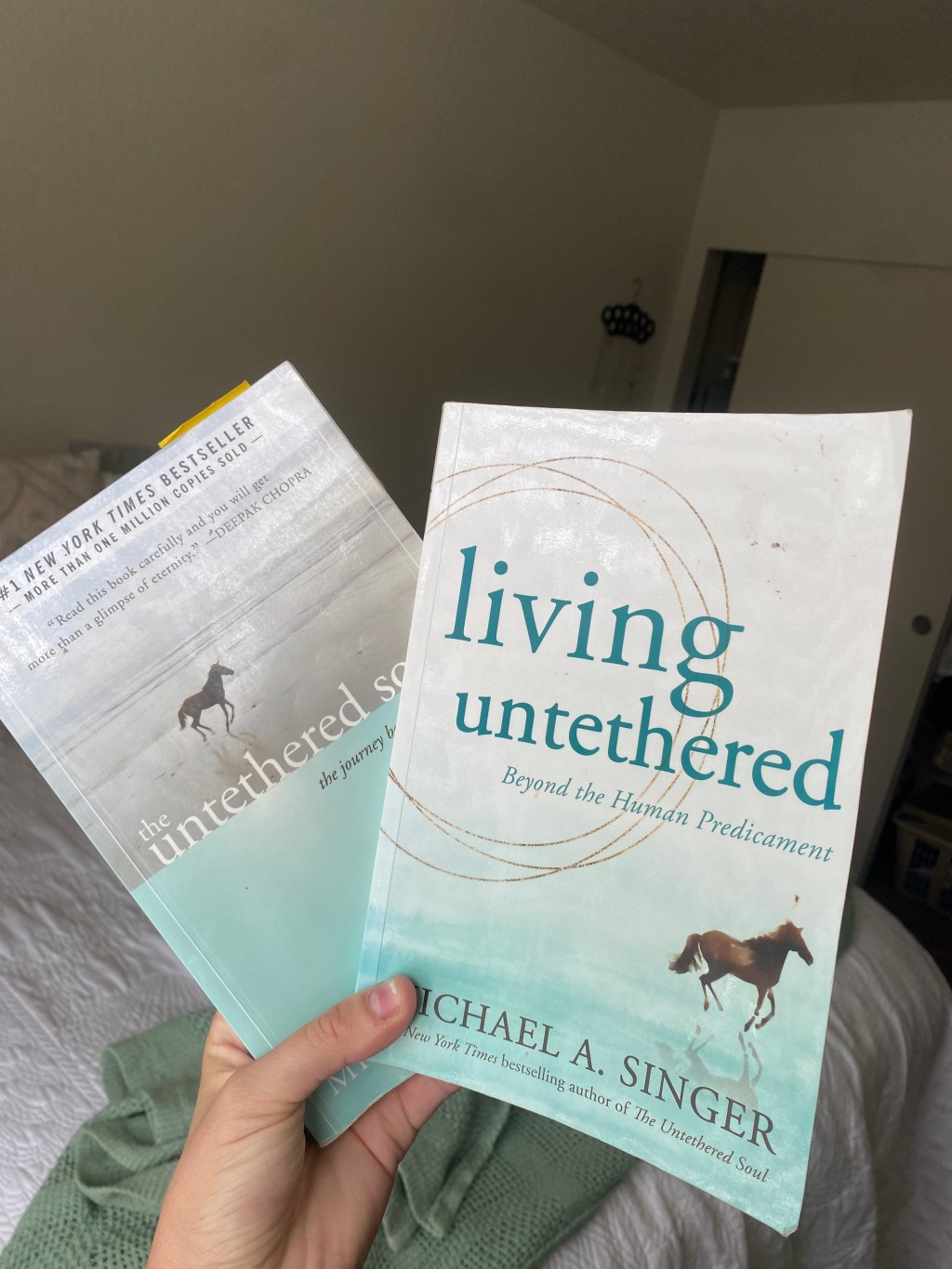
As was the case for many other people during the lockdown from COVID-19, I had lots of extra time on my hands. I have always been intrigued by deep concepts, and so when Instagram boomed with awareness around mental health and tips to improve, I quickly immersed myself in self-help books. Looking back five years later, I want to reflect on the book that I love the most from this time in my life, and one that I have dedicated lots of time to understanding deeply. It is Michael A Singer’s The Untethered Soul and the sequel, Living Untethered.
These books opened my eyes to spirituality in a new way. I came to find new techniques for cultivating a sense of calm and ease into my life. Here is a more in-depth look at three of the biggest changes that I experienced as I practiced these books’ teachings.
1. My Inner Thoughts Began to Dwindle
The first effect I noticed in myself after practicing these teachings was that my inner dialogue became quieter. Before, I had lots of inner thoughts that swarmed my head. These thoughts could be anything and everything, from “This person hates me,” to “Why did I do that,” and “I look so stupid,” etc. These negative thoughts and judgments consumed me.
This book taught me a different way to understand my thoughts. Singer acknowledges that we are not our thoughts, but the observer of our thoughts. He uses the term “your inner roommate” to allow us to we imagine our thoughts as a different entity living with us, much like a roommate would. We know that we are not our thoughts because we are able to observe them. Singer us the subject-object relationship – that we, the subject, can observe our thoughts, the object. Since we can observe them, that means we are not the same as our thoughts.
Since we are not the same as our thoughts, we do not have to give in to the chatter that they produce. We do not interact with this chatter. We sit back behind it in the “Seat of Self,” or the center of witness consciousness.
This simple shift in understanding was profound for me. In practice, instead of identifying with my thoughts, instead of behaving based on what they said, I would sit back and observe. With this process of unidentifying with my thoughts, my chatter would quickly diminish in the moment. It was almost as if it all stopped.
It took practice for this detachment process to become more automatic. But the more and more I practiced, the more surprised I got with how profound a change it made.
2. I saw life as a tool for releasing my stored patterns.
I also came to learn how to release my stored patterns, or samskaras, so that they no longer ran my life. Instead of using life to solve my internal problems, I used life to release them. Samskaras originates from the Hindu tradition. Singer a samskara as, “an unfinished energy pattern… a blockage, an impression from the past” (Singer 53).
Samskaras are our impressions of the world, and thus our understanding of what we like, dislike, and what we want and do not want in the future. It seems like a good thing to have preferences, however, they end up running our lives to the point where we avoid situations to stay comfortable, we get triggered at things, and our happiness is robbed when our high expectations are not met.
Singer points out that we will always have a problem when another is fixed. So, we can either allow these impressions to run our lives or choose to get rid of them.
For me, whenever I had a samakara that was touched and I would feel an uncomfortable emotion trigger, I would come close my heart. I would turn inward. I would wallow in my insecurity and spiral into shame. By letting go, I could stay open, no matter how uncomfortable the feeling. I would allow the energy to run through me, to release itself ultimately.
3. I began a journey of becoming whole.
“If the motive itself is pure and impersonal, in the end, it will spread light.”
Michal A Singer- Living Untethered page 199
By releasing samaskaras, a lot of my impressions came to cease. This led me to a place of more wholeness. By releasing personal blockages, I came to serve the present moment from a place of wholeness, not from a place with voids. The book encourages readers to not use the external world to solve our internal problems. We must simply notice each moment that passes in front of us.
Practicality
Spirituality itself is not against living in the world. It does not say do not interact with the world. We, of course, do have needs. At the most basic level, we need a sense of safety and security, we need human connections. Spirituality proposes a shift in perspective– one that says, we do not need things in the outside world to be a certain way to feel okay. We are okay first, then we interact with the world from a whole place.
“You might wonder why you would be motivated to do anything if you’re already that content. Why bother having a job, or even a relationship, if you’re already filled with so much love and happiness? The answer is simple: love wants to express itself and enthusiasm wants to create. Once the energy is no longer blocked and is following freely, personal needs are no longer your motivation. Your actions are the expression of love and gratitude for life. Your whole life becomes an act of service,” (Singer, 193).
If you get to a place of feeling infinite love and infinite energy, you will want to express and create with it.
Works Cited
Singer, Michael A. Living Untethered: Beyond the Human Predicament. New Harbinger Publications, 2022.
Singer, Michael A. The Untethered Soul: The Journey Beyond Yourself. New Harbinger Publications, 2007.
 In Common Light
Leave a comment