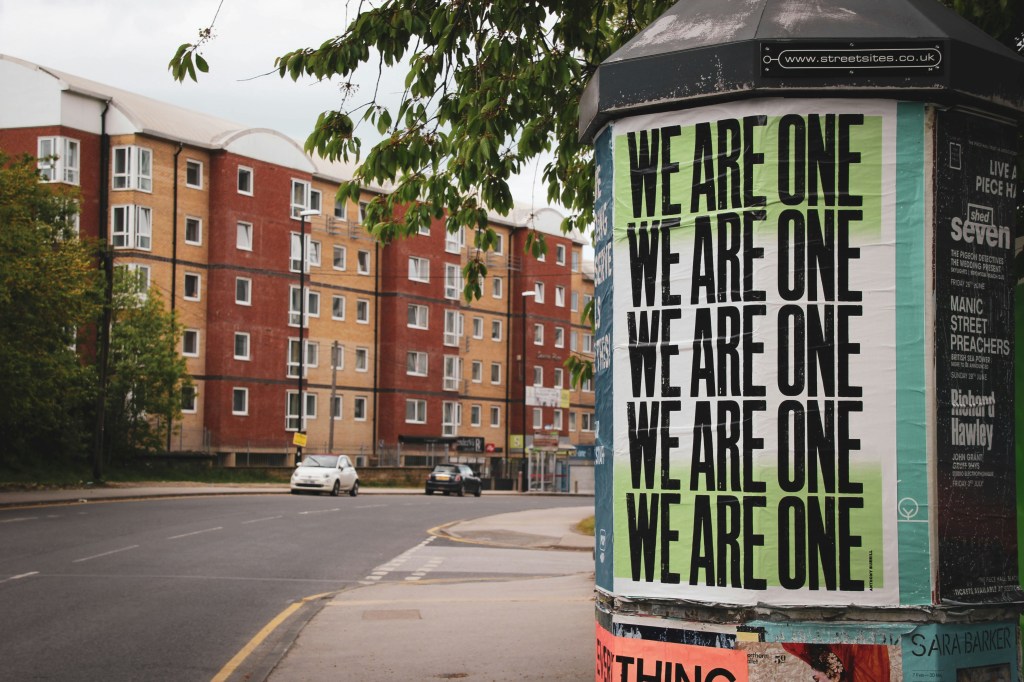
When we think of social revolutions, political movements, we often think of sit ins, protests, and large scale policy changes. But what if social and political changes also involved spiritual change? In other words, a change in the consciousness of a person?

Photo by Alex Radelich on Unsplash
Personal Narrative
As discussed in my posts about spirituality, I started to learn about eastern philosophies in 2020. I read Michael A. Singer’s “The Untethered Soul,” and, though I was initially hesitant about the practicality and usefulness of these philosophies, they became a cornerstone of my personal growth and contribute a large amount to my current day wellbeing.
I came to find out that these teachings also allowed me to be more politically open, in a way that I did not expect.
The book teaches you to treat the present moment as a neutral thing passing by your consciousness. This not only helped to stop my immediate problems (such as overthinking and anxiety); it also allowed me to clear larger energy blockages (see Letting Go: A Spiritual Practice and Letting Go Part 2).
When I started to learn in college about political and social facts that were new to me, I practiced this same thing – watching those emotions go and allowing them to pass through.
I started to do more learning on my own about politics and social histories that we are not taught in school. My spirituality said that we should not be attached to things in the real world, not take it personally, and this is how I went about this new type of learning.
It was my spiritual foundation that helped me sit through tough emotions and uncomfortable truths.
On a larger scale, this helped me to connect more to people that were different than me. It helped embrace my humanity in such a beautiful way. I could see people as more than a subgroup but for a human – someone with hopes, dreams, fears and insecurities just like me.
This spiritual journey showed me how we as individuals can expand our conscious awareness to better relate to people and be able to contribute to social movements.
Globalization
Globalization contributes to an expansion in social consciousness.
With more information, we can become more conscious. This sheds light on our shared human condition with other humans and increases our sense of humanity, motivating us to put our efforts towards political and social causes, contributing to a better world.
In the present day, we live in a very globalized world: “Largely due to developments in information technology (and especially the Internet, social networking and the like), globalization has taken a quantum leap forward over the last 30 years, with no apparent end in sight,” (Sander & Cavallin, 2015).
Knowledge Spread Leads to a Broader Social Consciousness
A contributor to globalization is the internet, which allows for knowledge spread on a large scale, leading to new ideas and perspectives in a way that we have not seen before. We are exposed to a wider range of information than before (think of the shift from TV cable and radio to streaming services). This means that the likelihood of me consuming different information than another individual, instead of watching the same show or listening to the same podcast, is less than it used to be. I tell my friend about it. This compounds over and over and across different people, leading to us overall having a broader knowledge base.
The spread of knowledge includes spread of different religions, which is how I was able to learn about Hindu and Buddhist philosophies.
Capitalism Has Met our Deficiency Needs
According to Maslow’s Hierarchy of Needs, we have a need for (starting from the most primal) for physiology and safety needs, and love and belonging (McLeod, 2026) (Brodie, 2024).
Fortunately, capitalism has fulfilled these three levels of needs. We have access to food and water (first level), we have access to shelter (second level) and we, with some interruptions or occasional difficulties, have the ability to develop connections (family and friends) (third level).
In modern day, we have AI, self-driving cars, and convenience in nearly every realm of our lives.
Advancing to Growth Needs
Globalization, offering a broader knowledge base, allows us to climb the ladder on Maslow’s Hierarchy of needs, towards self-actualization.
Self-actualization requires the differentiation from wants and needs , from separating from the obsession with materialism, and instead focusing on discipline, connections, growth through discomfort, and through helping the more vulnerable in our communities.
Self-Growth To Contribute to Social Change
Activist Grace Lee Boggs, who worked alongside Malcom X, discusses in her autobiography, Living for Change (1998), the need for us humans to “Transform ourselves as well as the victims of oppression into human beings who are more advanced in the qualities that distinguish human beings: creativity, consciousness, self-consciousness, and a sense of political and social responsibility” (pg. 152). This is especially the case, as she says, when the system of capitalism has hurt our psyche so much that we loose track of the importance of these qualities.
Scientific progress has outrun spiritual progress, still today as it was in the 60s, as described by Martin Luther King Jr in his 1964 Nobel Prize Lecture: “There is a sort of poverty of the spirit which stands in glaring contrast to our scientific and technological abundance. The richer we have become materially, the poorer we have become morally and spiritually. We have learned to fly the air like birds and swim the sea like fish, but we have not learned the simple art of living together as brothers,” (Horgan, 2015).
The way to reach a social revolution and to mend broken relations between races and classes and political parties is a spiritual revolution.
Scientific and Material Gains
We need to make the shift from over consumption and advancement in the field of technology and sciences, and into a zone of spiritual living and advancement in the field of the humanities.
We need to be able to face discomfort, not necessarily in the distinguishing needs, but in the growth needs. Boggs again says, “Precisely because the United States is so advanced technologically, precisely because it has developed an economic apparatus so productive that not only our needs but our wants can be satisfied, we cannot make a revolution without developing our human capacity to distinguish between needs and wants and to make responsible choices,” (pg. 152). We need to begin to detach ourselves from the incessant need to cling to materials and luxury, external things, and focus more on internal growth.
Martin Luther King Jr., in the same Nobel Prize Lecture, distinguishes betwen the external realm and the internal realm: “Every man lives in two realms, the internal and the external. The internal is that realm of spiritual ends expressed in art, literature, morals, and religion. The external is that complex of devices, techniques, mechanisms, and instrumentalities by means of which we live,” (Horgan, 2015). He then claims that “Our problem today is that we have allowed the internal to become lost in the external. We have allowed the means by which we live to outdistance the ends for which we live” (Horgan, 2015). In other words, scientific progress has outweighed spiritual.
Our interest in material looses grip when we take on a spiritual outlook (see my post materialism).
Raising Our Level of Consciousness for Social Change
Boggs discusses the difference between rebellion and revolution. She lists rebellion as a small-scale event that breaks the status quo and “throws into question the legitimacy and supposed permanence of existing institutions,” (pg. 153). But a revolution is more long term and helps to “Establish a new social order” (pg. 153). And, the distinction between the two is that revolution requires a change within a person. She says, “To make a revolution, people must not only struggle against existing institutions. They must make a philosophical/spiritual leap and become more ‘human’ human beings. In order to change/transform the world, they must change/transform themselves,” (pg. 153).
Boggs also worked to develop a James & Grace lee Boggs Foundation in order to help youth become involved in activism (James and Grace Lee Boggs Foundation). She states, “When they [the youth] can see themselves making a difference, they also become different. That has to be part – an integral part – of the process of revolution,” (NowThis, 2022, 3:14).
Takeaway
When we view social revolution as a spiritual endeavor, we can learn to liberate ourselves internally as well as externally.
Notes
Boggs, G. L. (1998). Living for change: An autobiography. University of Minnesota Press.
Brodie, K. (2024, August 12). Maslow’s hierarchy of needs for children: A comprehensive guide for early years professionals and students. Early Years TV. https://www.earlyyears.tv/maslows-hierarchy-of-needs/
Horgan, J. (2015, January 19). Martin Luther King’s haunting reflections on science and progress | scientific american. Scientific American. https://www.scientificamerican.com/blog/cross-check/martin-luther-king-jr-s-haunting-reflections-on-science-and-progress/
James and Grace Lee Boggs Foundation. (n.d.). James and Grace Lee Boggs Foundation. https://www.boggsfoundation.org/
McLeod, S. A. (2026, February 6). Maslow’s hierarchy of needs. Simply Psychology. https://www.simplypsychology.org/maslow.html
NowThis. (2022, March 23). Grace Lee Boggs’ lasting impact: AAPI activism then and now [Video]. YouTube. https://www.youtube.com/watch?v=PaHqpzZkJd0
Sander, Å., Cavallin, C. (2015). Hinduism Meets the Global Order: The “Easternization” of the West. In: Brunn, S. (eds) The Changing World Religion Map. Springer, Dordrecht. https://doi.org/10.1007/978-94-017-9376-6_92
Cover Photo by Marek Piwnicki on Unsplash


Leave a Reply